How Much Does Mixing and Mastering Cost in 2026?
Every price tier on the market - from $5 AI tools to $5,000 boutique mixes - explained by a working engineer, with the honest answer on what you actually get for your money.
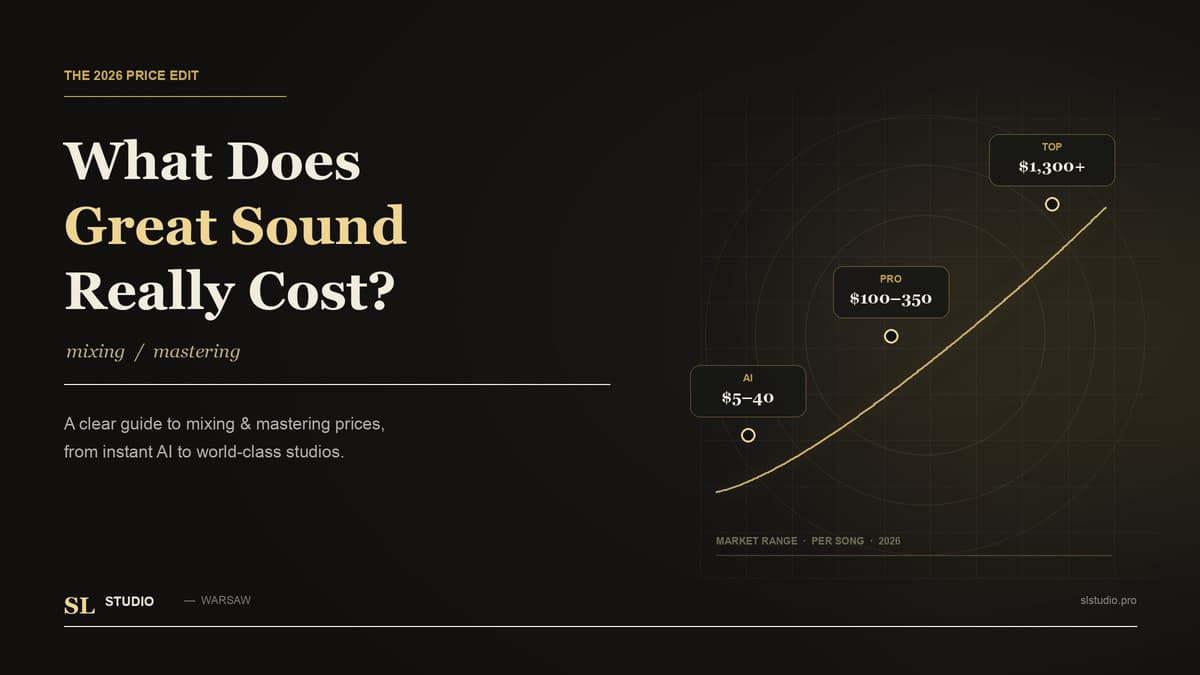
In 2026, mixing and mastering a single song costs anywhere from $5 with AI tools to $5,000+ at a top-tier studio. For most independent artists the realistic range is $100–$350 per track for a professional online mix and master; mid-tier engineers with major-label credits charge $475–$1,000.
That's the direct answer. The interesting part is why one engineer quotes $75 and another quotes $750 for what looks like the same job - and how to tell which one your release actually needs. I mix and master for a living, my own prices are public, and I have nothing to hide: let's take the whole market apart, tier by tier.
Contents
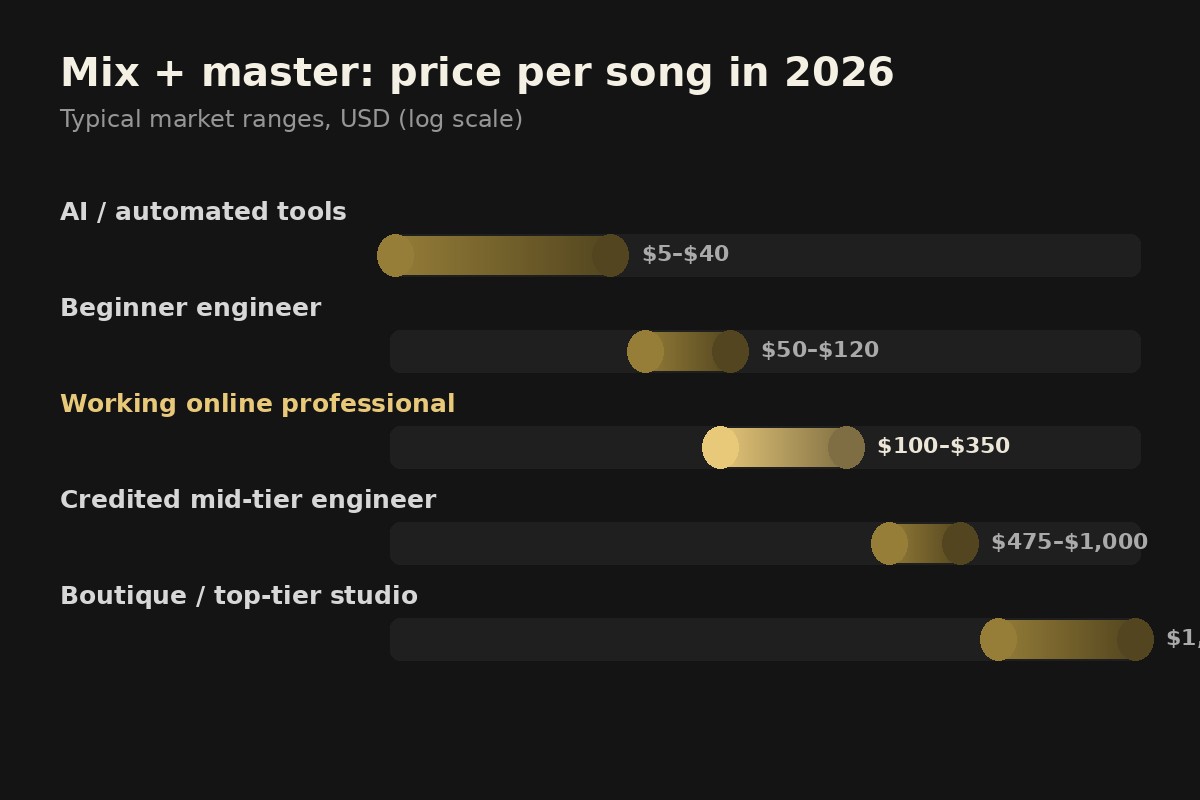
The Short Answer: 2026 Price Table
Every number below is per song, in US dollars, compiled from published 2026 rate guides, marketplace listings and what engineers actually quote clients - not from anyone's marketing page.
| Tier | Mixing | Mastering | Mix + Master |
|---|---|---|---|
| AI / automated tools | — | $5–$40 | $5–$40 |
| Beginner engineer | $25–$75 | $20–$50 | $50–$120 |
| Working online professional | $80–$300 | $30–$100 | $100–$350 |
| Credited mid-tier engineer | $400–$800 | $75–$200 | $475–$1,000 |
| Boutique / top-tier studio | $1,000–$5,000+ | $300–$1,000+ | $1,300+ |
The spread looks absurd until you realize the tiers are selling different products. The bottom sells processing. The middle sells experienced ears with low overhead. The top sells credits, priority access and a brand name on your liner notes. The sound quality curve flattens out much earlier than the price curve does.
What You're Actually Paying For
A mixing invoice is really five costs stacked on top of each other:
- Ears and experience. The core product. An engineer who has mixed 500 songs hears problems in 30 seconds that a beginner won't find in a week.
- Session complexity. 12 clean stems is one job; 60 tracks with bleed, timing issues and untuned vocals is a very different one. Most engineers price by stem count for exactly this reason.
- Revisions. Included rounds cost the engineer real hours, so "2 revisions included" vs "unlimited" changes the honest price.
- Deliverables. A WAV master is standard. Stems, instrumentals, a cappellas, Dolby Atmos versions - each adds work and shows up in the quote.
- Overhead and brand. Commercial room rent, staff, a famous name. This is the part of the price that does NOT reach your ears - and the part online engineers cut out.
Pro Tip
When comparing quotes, mentally subtract the overhead. Ask: which part of this price is ears, and which part is real estate? A $600 mix from a commercial studio and a $150 mix from the same quality engineer working from a treated home room can be the same product.
Mixing Prices by Tier
Beginner ($25–$75). Students and hobbyists building a portfolio. Results are a lottery: sometimes surprisingly good, often template processing on every track. Fine for demos, risky for a release you promote.
Working online professional ($80–$300). The sweet spot for independent artists in 2026. Experienced engineers working remotely from treated home studios, often outside expensive Western capitals. UK rate guides put this tier at £80–£250 per mix; the best of them deliver work that competes head-on with in-person sessions.
Credited mid-tier ($400–$800). Engineers with verifiable major releases. US guides cluster this tier at $400–$800 per mix. You are paying for a proven track record and a deeper bench of reference points - worth it when a label, sync agent or serious playlist push is involved.
Boutique / top-tier ($1,000–$5,000+). Grammy-credited names. At this level you buy priority, brand and politics as much as sound. Even engineers inside this tier admit publicly that a caring mid-tier pro often delivers the same sonic result.
Pro Tip
Judge every tier the same way: ask for a before/after in your genre. A raw-stems-to-final comparison tells you more in two minutes than any price tag, credit list or review page.
Mastering Prices (and AI Tools)
Mastering is cheaper than mixing because it's one stereo file, not sixty tracks - but the tier logic is identical:
| Option | Price per track | Best for |
|---|---|---|
| AI (LANDR, eMastered, etc.) | $5–$40 | Demos, drafts, frequent uploads |
| Entry-level engineer | $20–$50 | Budget releases, learning projects |
| Working professional | $30–$100 | Independent singles and EPs |
| Boutique specialist | $100–$300 | Vinyl, genre-critical releases |
| Top-tier mastering house | $500+ | Label projects, big budgets |
About AI: LANDR charges $10 for a single track master and subscriptions start around the price of one human master per month. For work-in-progress checks that's genuinely useful. The ceiling is just as real: an algorithm can't fix a muddy mix, can't decide the chorus should hit harder than the verse, and still tends to over-brighten and over-compress. If the track matters, a human touches it - here's a detailed breakdown of why AI processing sounds cheap and what fixing it involves.
Budgeting a Single, EP and Album
Published 2026 guides aimed at US indie artists suggest budgeting $300–$700 per single (mix + master combined), $1,200–$2,500 for a 4–6 track EP and $1,500–$3,500 for a full album at the credited mid-tier level.
Those numbers are honest - for that tier. Working with an online professional, the same scope typically lands at $100–$350 per single, $400–$900 per EP and $900–$1,500 per album, usually with a bulk discount baked in.
Pro Tip
Don't split the budget evenly. Put the most money and revision time into your lead single - the track that runs in ads and playlists - and use the standard rate for the rest. Nobody streams track 9 first.
Red Flags When Comparing Prices
- The premium trap. $1,000+ per track "because of the name" with no recent work you can verify. Engineers discuss this openly: above the mid-tier, price stops correlating with sound.
- The $20 "radio-ready" factory. 24-hour turnaround, unlimited revisions, five-star everything. That economy only works with template presets dropped on every song. You can hear it.
- No before/after examples. A polished showreel proves nothing - raw-to-final comparisons in your genre do.
- Vague revision policy. If it's not written down before payment, round two becomes a paid extra surprisingly often.
- Hidden per-stem fees. A $99 headline price that becomes $240 after "vocal tuning", "drum editing" and "more than 20 tracks" surcharges.
- Promises of placement. "Guaranteed playlists" or "label attention" bundled with a mix is marketing, not engineering.
Where My $39/$89 Fits In
Full transparency, since this whole article is about prices: at SL Studio I charge $39 for mastering, $89 for a full mix & master and $119 with arrangement work included. On the table above that's the working-professional tier at the lower edge of its range.
How is that possible without cutting corners? The boring math of overhead. I work online from a treated studio in Warsaw: no commercial rent in a Western capital, no staff, no receptionist baked into your invoice. You work directly with the engineer who actually opens your session. Industry guides point out the same arbitrage: comparable quality costs 20–40% less outside major Western cities. That discount is real - it just isn't a discount on the ears.
And because trust is the honest bottleneck at every tier, I solve it the direct way: you send a track, I process a preview, you listen before paying anything. The before/after test from section 3 - applied to your own song instead of someone else's demo.
How to Pay Less Without Losing Quality
- Prep your session. Labeled stems, no clipping, edits done, one take per track. Engineers who price by complexity will quote you less - and the mix gets better too.
- Bring references. Two or three commercial tracks that sound the way you want cut revision rounds dramatically. Fewer rounds, lower effective cost.
- Ask for bundle rates. Almost every engineer discounts EPs and albums; many just don't advertise it.
- Use geography. A great engineer in Warsaw, Lisbon or Belgrade costs less than the same ears in London - same internet, same WAV files.
- Don't pay twice.The most expensive mix is the cheap one you have to redo. If the budget is tight, master-only ($30–$100) on a decent self-mix beats a bargain-bin full mix.
Ask Before You Pay: Checklist
Before/after examples in YOUR genre (not just a polished showreel)
Revision policy in writing - how many rounds, what counts as a revision
Exact deliverables: WAV master, MP3, instrumental, stems if you need them
Turnaround time and what happens if it slips
Who actually mixes your track (studios often outsource to juniors)
A per-EP or per-album rate if you have more than two songs
Whether you can hear a preview or test before committing the full fee
FAQ
Is $100 enough for a professional mix and master in 2026?
In a commercial studio in LA or London - no, $100 barely covers an hour of room time. Online, working directly with an engineer who has no rent and no staff - yes, absolutely. The honest test is not the price tag but the before/after examples in your genre. If the engineer can show a raw session turned into a release-ready track, the number on the invoice matters far less than people think.
Why do prices range from $5 to $5,000 for the same service?
Because you are paying for three different things at once: the engineer's ears and experience, their overhead (commercial room, staff, gear amortization), and their name. The sound quality curve flattens quickly - a $500 mix is rarely five times better than a $100 mix. Above the working-professional tier you are increasingly paying for credits, priority and brand, not for extra decibels of quality.
Do I need separate engineers for mixing and mastering?
The classic argument for a separate mastering engineer is fresh ears and a second room. It still holds for big-budget releases. For independent singles in 2026, a good engineer who mixes AND masters your track - while checking it against commercial references - delivers a result the listener cannot tell apart. What actually matters is that mastering is not skipped entirely.
Is AI mastering (LANDR, eMastered) good enough?
For demos, drafts and frequent low-stakes uploads - yes, $5-40 per track is unbeatable value. For a release you promote, AI hits its ceiling: it cannot fix a mix problem, it cannot make taste decisions, and it tends to over-brighten and over-compress. Typical workflow in 2026: AI for work-in-progress checks, a human engineer for the version that goes on your artist profile.
How much should I budget for a whole album?
Mid-tier US/UK engineers quote roughly $1,500-$3,500 for a 10-12 track album (mix + master). Online professionals with lower overhead do the same scope for $900-$1,500, often with a bulk discount. A practical strategy: spend more on your lead single, use the standard rate for the rest, and always ask for an album price - almost everyone has one.
How many revisions should be included in the price?
Two to three included revision rounds is the industry standard in 2026. 'Unlimited revisions' sounds generous but usually signals either a beginner building a portfolio or a factory that counts on you giving up after round two. More important than the number: the revision policy should be written down before you pay.
Want to hear what $89 buys before you spend it?
Send me your track and get a free processed preview - you listen first, then decide. Mastering $39, mix & master $89, no hidden per-stem fees.
Get a Free Preview →Want your track to sound like this?
Send it in and get a free preview — hear the difference on your own song before you pay anything.
Get a free preview →