
Mixing Guitar-Driven Rock — A Wall of Guitars That Still Breathes
Modern rock lives or dies on density. Here is how a guitarist-engineer builds a wall of guitars that hits hard without turning into mud.
I have already written about how I hear blues rock — a sparse genre where every element is exposed and there is nowhere to hide. Guitar-driven rock in the modern sense is the opposite problem. Nothing is exposed, because everything is stacked: two, four, sometimes eight rhythm guitar tracks, layered leads, thick bass, a drummer fighting to be heard over all of it.
As a guitarist, I love that density — a proper wall of guitars is one of the greatest sounds in recorded music. As a mixing engineer, I know it is also where most self-produced rock falls apart. The tracks are fine. The performances are fine. But everything occupies the same frequency range at the same time, and the result is a loud, grey blur. This article is about avoiding that — the actual decisions, not vague advice.
The Wall of Guitars Starts at the Source
Real doubles, not copies. The foundation of every big rock rhythm sound is double-tracking: the same part performed twice and panned hard left and right. The two performances are never identical — tiny timing and pitch differences between them are literally what your brain reads as “wide”. Copying one take to both sides does not create width; it creates one louder mono guitar. If you only have one take, record the double. It is the single highest-value hour you can spend on your production.
Stack tones, not just tracks. When doubling, change something: a different pickup position, a different amp or sim, a slightly different gain setting. Two complementary tones panned apart sound wider and denser than the same tone twice, because each side contributes different harmonic content. Classic move: a tighter, brighter tone on one side, a warmer, fatter one on the other.
Less gain than sounds right solo. High-gain guitars stack badly — distortion is already compression, and four saturated tracks together smear into wash. The trick every experienced rock producer knows: dial in less gain per track than sounds impressive in isolation. Four moderately driven tracks sound enormous together; four fully saturated tracks sound like a swarm of bees. Layers add the thickness that gain does not have to.
The mono test for doubles. Collapse the mix to mono. If your doubled guitars mostly disappear or turn hollow, the two takes are fighting — usually a timing issue, occasionally polarity. Fix the takes, not the EQ. A great double survives mono; it just gets narrower.
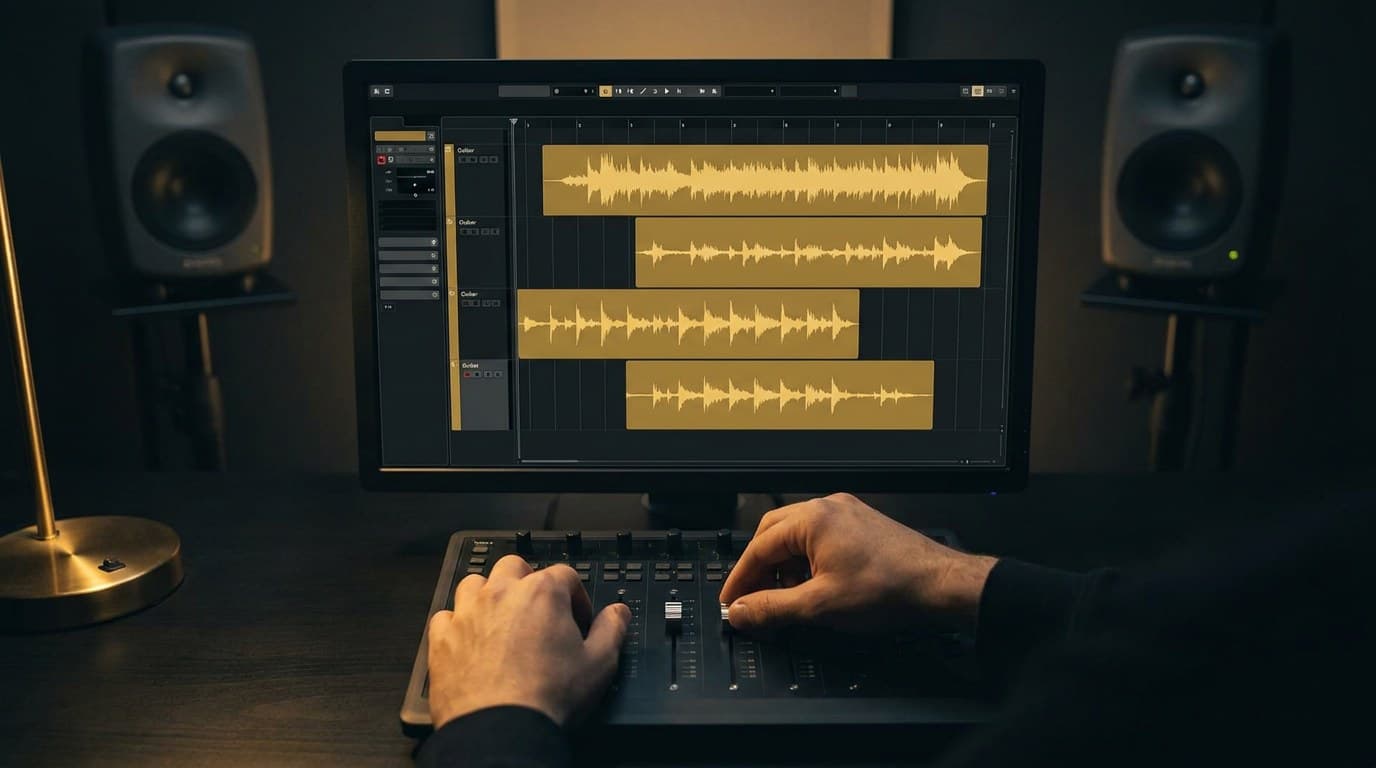
Carving Space — the Midrange War
Distorted guitars generate energy almost everywhere, but they live in the midrange — exactly where the vocal lives, and where the snare cracks, and where the bass defines its note. In a guitar-driven arrangement, the midrange is a war zone, and the mix is the peace treaty.
The vocal owns 1–4 kHz. That is where speech intelligibility sits, and no amount of vocal volume fixes a guitar that is camped on top of it. I cut the rhythm guitars narrowly in the exact zone where this particular vocal needs air — usually a 2–3 dB notch somewhere between 1.5 and 3 kHz, found by ear, not by preset. Done right, nobody hears the cut; they just suddenly understand the words.
The bass owns the floor. High-pass the distorted guitars — typically somewhere between 80 and 120 Hz depending on the tuning — and let the bass guitar carry the weight alone. Palm-muted riffs put surprising energy at 100–200 Hz; if the low end pumps and blurs on chugs, that zone is usually the culprit. The counter-intuitive part: guitars high-passed this way sound bigger in the mix, because the bass beneath them is finally clean.
Do not scoop the character out. The classic beginner fix for “muddy guitars” is a huge midrange scoop. It makes the guitar sound impressive solo and invisible in the band — the same trap as on a stage amp. Narrow, surgical cuts where things actually collide preserve the tone; broad scoops erase it.
Drums That Punch Through the Wall
The snare needs two anchors. Body around 200 Hz so it feels solid, and crack in the 3–5 kHz zone so it cuts. Dense guitars mask the crack first — which is why a snare that sounded huge in the drum session vanishes the moment the rhythm tracks come up. I balance the snare against the full wall of guitars, never against muted tracks.
Parallel compression is the rock drum cheat code. A heavily crushed parallel drum bus — high ratio, aggressive gain reduction — blended back at 20–30% under the clean kit adds density and excitement while the dry signal keeps the dynamics alive. This is how live-sounding drums survive next to four tracks of distortion.
Cymbals and distorted guitars want the same real estate. Both fill the 6–10 kHz zone with wash. Two options: darken the guitars slightly with a gentle low-pass and let the cymbals shimmer, or tame the overheads and let the guitars carry the top. Choosing one deliberately is the difference between “bright” and “harsh”. Trying to have both at once is how ear fatigue happens.
Making the Chorus Actually Hit
If every section of the song has every layer playing, the chorus cannot get bigger — there is nowhere left to go. The loudest wall in the room is the one that was not there a second ago.
Reserve layers for the chorus. Verses on one or two guitar tracks, slightly narrower and drier; choruses open up to the full quad-tracked width. Even when the band recorded wall-to-wall guitars, I will often pull the verse doubles down or narrow their panning so the chorus has something to reveal.
Automation beats static balance. A rock mix is not a photograph, it is a film. The 1–2 dB vocal ride into the hook, the lead guitar pushed forward for eight bars and pulled back, the extra kick energy in the last chorus — these small moves are what make a mix feel alive and expensive. Most of my mixing time on rock goes into automation, not plugins.
Mastering Rock Without Flattening It
Dense rock already has very little dynamic range by nature — the guitars are compressed by their own distortion before a single plugin touches them. That makes the mastering stage dangerous: there is not much headroom for error, and over-limiting kills the one dynamic element left, the drums.
For guitar-driven rock I typically land between -10 and -12 LUFS integrated — competitive loudness that still lets the snare snap. Spotify and Apple Music normalise playback anyway, so a master crushed to -8 LUFS is not louder for the listener; it is just flatter. What survives normalisation is punch, and punch comes from transients, not limiter settings.
What to Send for the Best Result
- → Every track exported individually from bar one, all the same length (full stem-export guide here)
- → Each rhythm guitar double as its own track — do not bounce layers together
- → Dry DI tracks alongside your printed amp tones, if you have them
- → No limiter or compressor on the master bus
- → A reference track — the record whose density and punch you are chasing
- → BPM, key, and a note about what matters most in the song
Frequently Asked Questions
Do you work with amp sims and home-recorded DI tracks?
Yes — most modern rock that comes in was recorded at home through amp sims, and some of it sounds excellent. If you include the dry DI tracks alongside your printed tones, even better: when a tone fights the mix, I can re-voice it instead of fighting it with EQ. A great performance through a plugin beats a mediocre performance through a vintage stack every time.
How many guitar tracks is too many?
There is no magic number — I have mixed songs that needed two tracks and songs that genuinely used twelve. The real test: mute any single layer, and if the chorus does not get noticeably smaller, that layer was not adding anything, only taking clarity away. Send everything you recorded and we decide together what earns its place.
Can you make my rock track loud without squashing it?
Loud and crushed are not the same thing. Dense rock typically masters comfortably to around -10 to -12 LUFS while keeping the transients that make drums punch. Streaming platforms normalise loudness anyway, so a master pushed to -8 LUFS just sounds smaller and flatter at the same playback volume. I aim for impact, not a number.
My drums are programmed — is that a problem?
Not at all. Well-programmed drums are standard in modern rock production. What matters is velocity variation and sample quality. If the programming is stiff, I can humanise timing and dynamics, and where needed blend or replace samples so the kit holds its own against a wall of guitars.
How long does mixing take and how many revisions are included?
Most singles are delivered within 3 to 5 business days, with up to three revision rounds included. Clear references and notes about what matters most in your track usually get us there in one or two rounds.
Not sure what your track needs?
Send it and hear a free 60-second preview — an honest assessment and an exact price, no commitment.
Get a Free Preview →Want your track to sound like this?
Send it in and get a free preview — hear the difference on your own song before you pay anything.
Get a free preview →